Our site contains ads and uses Amazon affiliate links. We may earn a small commission at no extra cost to you. We know ads can be distracting, and we’re sorry for any inconvenience they cause. It helps us keep the site running. Thanks for your understanding and supporting us!
Most lemon raspberry cakes fail at the same two points. The lemon flavor fades after the first day because the zest was stirred into wet ingredients where its volatile oils dissolve too fast.
And the raspberries turn the crumb a streaky grey-purple because they hit the batter warm and start releasing juice immediately.
Both problems are solved by understanding what happens to these two ingredients chemically during mixing. This recipe walks through every decision with the science behind it, so you know exactly why each step matters and what to do if something goes wrong.
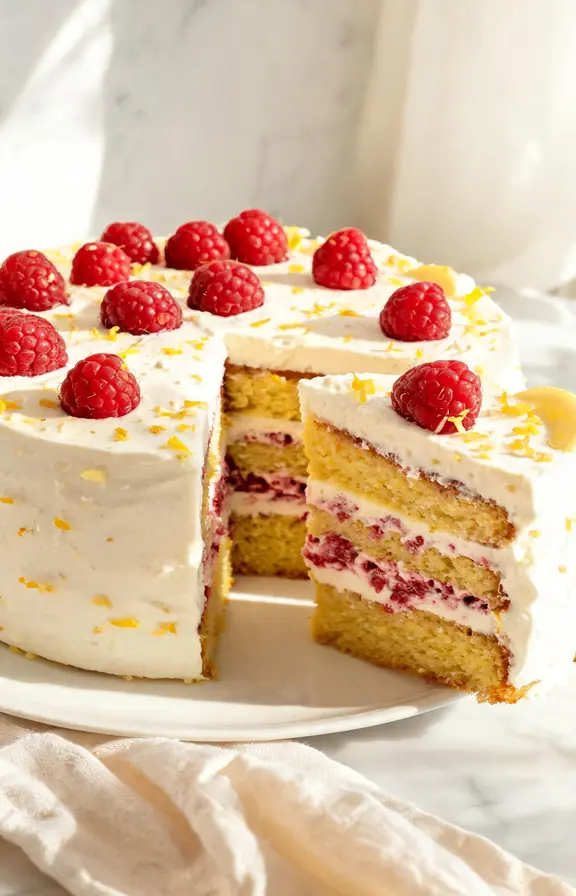
The result is a three-layer cake with deeply lemony crumb, whole raspberry pockets that hold their shape inside the bake, and a cream cheese frosting that stays firm enough to slice cleanly at room temperature.
For the frosting, the same technique covered in our guide to making silky, stable cream cheese frosting that never turns runny applies directly here.
Why Thermal Sequencing Changes the Lemon Flavor Entirely
Lemon zest contains limonene and linalool, two aromatic compounds that are responsible for the bright, floral citrus character you want in this cake. These compounds are oil-soluble, not water-soluble.
When you zest a lemon and drop it straight into butter or a wet batter, those essential oils disperse into the fat and lose intensity fast under heat. The cake comes out of the oven smelling incredible, then tastes flat on the plate.
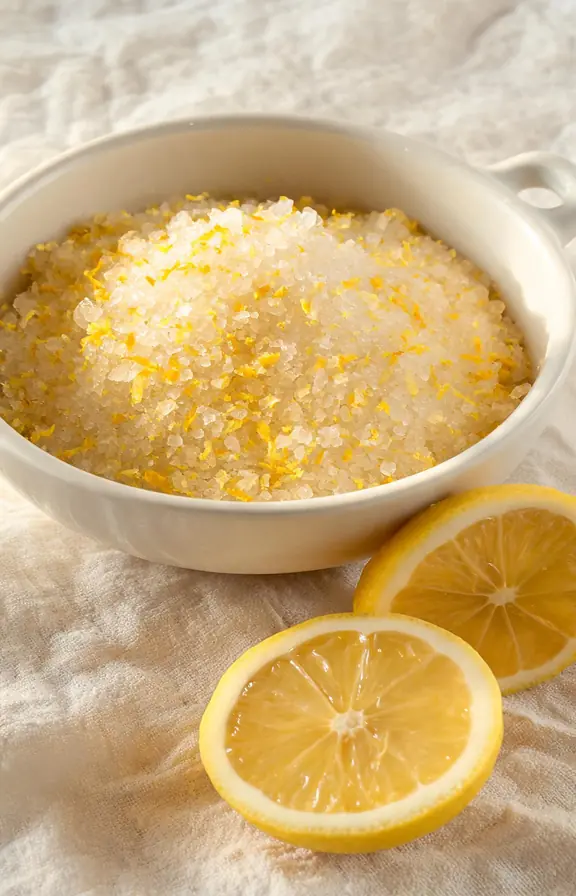
The fix is to rub the zest into the granulated sugar first, before anything else touches it. The friction and the dry sugar crystals act as a carrier, coating themselves in lemon oil. That oil-coated sugar then distributes evenly through every gram of the batter and stays aromatic through the full bake.
The Raspberry Problem: Why Cold Berries and Flour Coating Both Matter
Fresh raspberries are fragile. They are made up of small drupelets packed with juice and anthocyanin pigments.
When they hit warm batter, those pigments start leaching out immediately, turning the surrounding crumb grey-purple before the cake even goes into the oven.
Two things prevent this. First, keep your raspberries cold. Pull them from the fridge immediately before folding them in. Cold berries hold their structure longer in the batter because the heat transfer from the room-temperature batter is slowed.
Second, toss the cold berries in one and a half tablespoons of all-purpose flour before adding them.
The flour creates a light dry coating around each berry that absorbs surface moisture and prevents the drupelets from sticking together or sinking to the bottom of the cake pan.
Butter Plus Oil: The Crumb Science Behind a Cake That Stays Moist for Days
All-butter cakes taste richer but go stale faster. The fat in butter is largely saturated and solidifies below 60 degrees Fahrenheit, which means a butter-only crumb turns firm and dry within 24 hours of refrigeration.
All-oil cakes stay moist longer but lack the complex dairy flavor that makes a lemon cake taste like something you would order at a good bakery.
This recipe uses a measured split: three-quarters butter for flavor, one-quarter neutral oil for staying power.
The oil keeps a small percentage of the fat liquid even when the cake is chilled, which is why slices pulled straight from the refrigerator still have a soft, yielding crumb.
Greek yogurt adds a second layer of moisture retention. The proteins in yogurt bind water molecules into the crumb structure during baking, and the natural acidity of yogurt reacts with baking soda to produce extra lift.
A cake baked in a quality nonstick surface, like a well-seasoned light-colored aluminum pan, helps distribute this heat evenly so the butter-oil crumb sets without over-browning the sides.
Our breakdown of how fat ratios affect cake frosting texture and stability goes deeper on how the fat-to-structure ratio shapes the final eating experience.
Building the Layers: Assembly Tips That Keep the Stack Stable
Lemon raspberry cakes collapse during slicing because the berry filling between layers acts like ball bearings. Raspberries are round and the juice they release makes every surface slippery.
Three things prevent this. First, chill the frosted cake for 20 minutes between applying the crumb coat and the final frosting layer. This firms the crumb coat into a shell that holds the layers in place before you add weight from frosting above.
Second, use a small amount of frosting as an outer dam around the edge of each layer before spooning on any raspberry filling or fresh berries.
Pipe a half-inch ring of frosting around the circumference of each layer using a piping bag or a zip-lock bag with one corner snipped. This dam keeps the filling from migrating to the edge and bulging out when the next layer compresses it.
Third, place the cake on a flat surface after stacking and press gently straight down from the top center with your palm to settle the layers evenly before frosting the exterior.
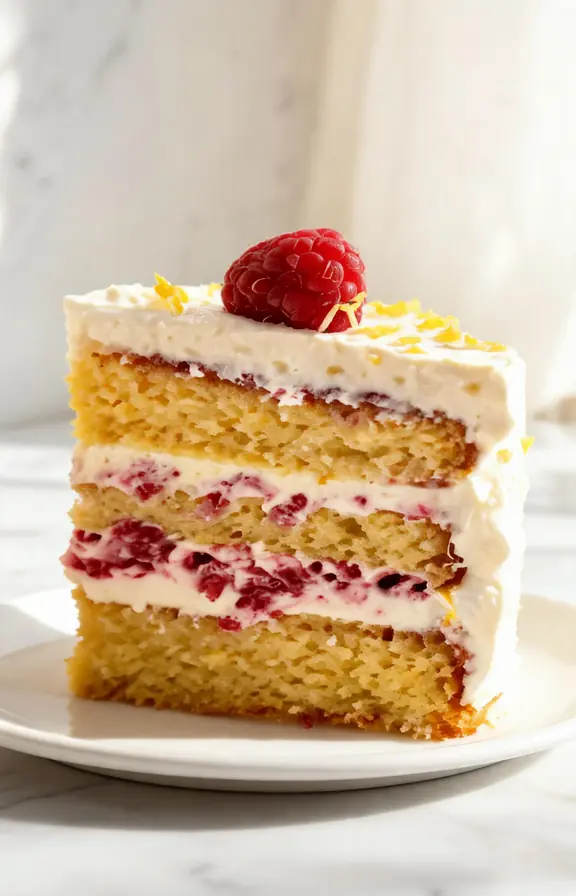
How to Make Cream Cheese Frosting That Does Not Slide Off in Warm Rooms
Cream cheese frosting melts and slides because the cream cheese contains water that separates from the fat when the frosting warms up. Three variables control this: the temperature of your cream cheese, the ratio of cream cheese to butter, and the order of mixing.
Always use block cream cheese, not tub cream cheese. Tubs contain stabilizers and extra water. Brick cream cheese has a firmer fat structure that holds shape at room temperature.
Let the cream cheese soften at room temperature for exactly 30 minutes before beating. Not longer. Over-softened cream cheese breaks down and the frosting will never stiffen back up.
Beat the cream cheese alone first until completely smooth with no lumps, then add softened butter and beat again before adding any powdered sugar. Adding powdered sugar to lumpy cream cheese traps the lumps permanently.
Fresh lemon juice stirred in at the end adds brightness without thinning the frosting, as long as you add it one teaspoon at a time and beat thoroughly between each addition.
Frequently Asked Questions
Lemon Raspberry Cake
Three layers of bright, moist lemon cake packed with whole raspberries, filled and frosted with tangy cream cheese frosting. Zest-infused sugar and a butter-oil split keep the flavor bold and the crumb soft for days.
- Three 8-inch round cake pans
- Stand mixer or hand mixer
- Kitchen scale (recommended for accurate flour measurement)
- Microplane or fine zester
- Rubber spatula
- Offset spatula for frosting
- Cake turntable (optional but helpful)
- Wire cooling rack
- 2 cups (250g) all-purpose flour, plus 1.5 tbsp for coating berries
- 2 teaspoons baking powder
- 1/2 teaspoon baking soda
- 1/2 teaspoon fine salt
- 1 1/2 cups (300g) granulated sugar
- Zest of 3 medium lemons (about 3 tablespoons)
- 3/4 cup (170g) unsalted butter, room temperature
- 3 tablespoons neutral oil (sunflower or canola)
- 3 large eggs, room temperature
- 1 cup (240g) full-fat Greek yogurt, room temperature
- 3 tablespoons fresh lemon juice
- 1 teaspoon pure vanilla extract
- 2 cups (250g) fresh raspberries, kept cold
- 16 oz (450g) block cream cheese, softened 30 min at room temperature
- 1/2 cup (113g) unsalted butter, softened
- 3 cups (375g) powdered sugar, sifted
- 2 tablespoons fresh lemon juice
- 1 teaspoon pure vanilla extract
- Pinch of fine salt
- Infuse the sugar with lemon zest Combine the granulated sugar and lemon zest in your mixing bowl. Using your fingertips, rub the zest into the sugar for a full two minutes until the sugar turns pale yellow and smells intensely of lemon. This step releases the essential oils from the zest into the sugar crystals and is the key to bold lemon flavor that survives baking. Do not skip or shorten this step.
- Prep pans and preheat oven Preheat oven to 350 degrees F (175 degrees C). Grease three 8-inch round cake pans generously with butter or nonstick spray. Line the bottom of each pan with a circle of parchment paper and grease the parchment too. This double-grease method ensures the layers release cleanly every time.
- Mix dry ingredients In a medium bowl, whisk together the flour, baking powder, baking soda, and salt. Set aside. Do not sift the flour unless your flour has visible lumps. Whisking is sufficient to distribute the leaveners evenly.
- Cream butter into the lemon sugar Add the softened butter to the lemon sugar in your mixing bowl. Beat on medium speed for 4 full minutes until the mixture is pale, fluffy, and noticeably increased in volume. Add the oil and beat for one more minute. The oil will look slightly separated at first but will incorporate as you add the eggs. Scrape down the sides of the bowl with a rubber spatula before the next step.
- Add eggs and wet ingredients Add the eggs one at a time, beating for 30 seconds after each addition. In a small bowl or measuring cup, stir together the Greek yogurt, lemon juice, and vanilla extract. With the mixer on low, add the flour mixture and yogurt mixture alternately to the bowl, beginning and ending with flour. Use three additions of flour and two additions of yogurt. Stop mixing as soon as the last streak of flour disappears. Overmixing after the flour is added develops gluten and makes the crumb tough.
- Coat and fold in cold raspberries Pull the raspberries from the refrigerator. Place them in a small bowl and toss immediately with 1.5 tablespoons of flour until each berry has a light, even coating. Tip the coated berries into the batter and fold gently with a rubber spatula using no more than 8 to 10 folds. You want the berries distributed but not broken. A few whole berries on the surface of the batter when it goes into the pans is fine and expected.
- Bake the layers Divide the batter evenly among the three prepared pans. Use a kitchen scale if possible: each pan should hold approximately the same weight of batter so the layers bake and cool at the same rate. Bake at 350 degrees F for 30 to 35 minutes. The tops should spring back when pressed gently in the center. A toothpick inserted into the center should come out with only dry crumbs, not wet batter. Avoid opening the oven before the 28-minute mark.
- Cool and make the frosting Cool the layers in their pans for 15 minutes, then run a thin knife around the edges and turn them out onto wire racks. Peel off the parchment immediately. Allow to cool completely, at least 1 hour, before frosting. For the frosting: beat the cream cheese alone until completely smooth. Add softened butter and beat until fluffy. Add sifted powdered sugar one cup at a time, beating on low after each addition. Add lemon juice one teaspoon at a time, beating between additions, then vanilla and salt. Taste and adjust lemon juice as needed. Refrigerate the frosting for 15 minutes if it feels too soft to spread.
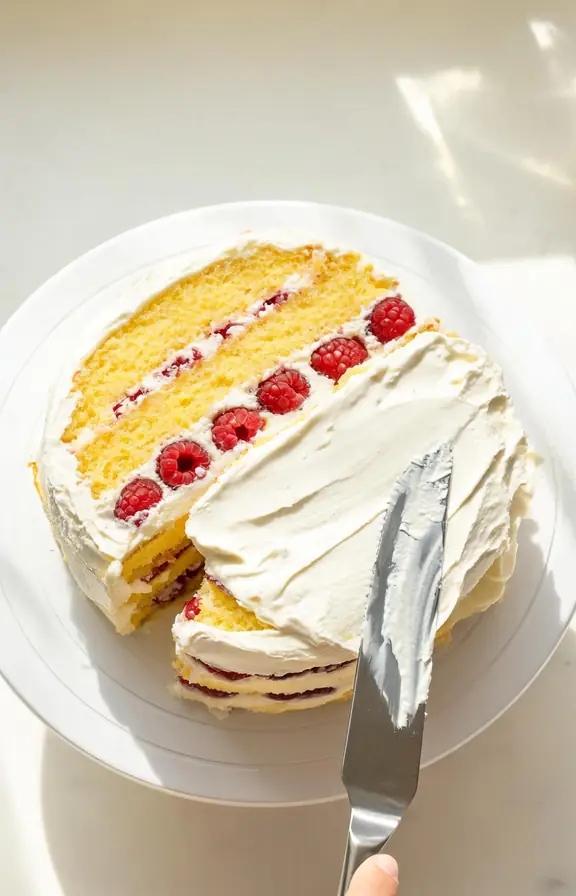
- Assemble and frost the cake Place the first layer on your serving plate or cake board. Pipe or spread a ring of frosting around the outer edge to create a dam. Fill the center with a generous layer of frosting and press a handful of fresh raspberries into it gently. Repeat with the second layer. Place the third layer on top and press down lightly with your palm. Apply a thin crumb coat of frosting over the entire cake and refrigerate for 20 minutes. Apply the final, full layer of frosting using an offset spatula. Decorate with fresh raspberries and lemon slices if desired.
Nutritional values are estimates calculated using standard USDA food composition data. Actual values will vary based on specific ingredient brands used, exact portion sizes, and whether additional fresh raspberries are added to the assembled cake.