Our site contains ads and uses Amazon affiliate links. We may earn a small commission at no extra cost to you. We know ads can be distracting, and we’re sorry for any inconvenience they cause. It helps us keep the site running. Thanks for your understanding and supporting us!
Most sourdough discard hamburger buns end up with one of two problems. They are too dense because the discard does not have enough active yeast to lift an enriched dough.
Or they are too tight in crumb because the baker skipped the enrichment step entirely and treated discard like a hydration-neutral add-in.
Neither problem is hard to solve. But you need to understand what sourdough discard actually does to dough before you can fix it.
This recipe walks through the mechanics of every decision:
- why a tangzhong paste changes the texture,
- how discard hydration affects your flour ratio,
- what proofing looks like at every stage,
- exactly how to freeze these buns so they come out of the freezer tasting freshly baked.
Why Sourdough Discard Makes Better Burger Buns (When Used Correctly)
Sourdough discard is not dead starter. It still contains wild yeast and lactic acid bacteria, even after sitting in your fridge for a week.
Those organisms contribute two things to a hamburger bun: a subtle, complex tang that plain milk buns lack, and organic acids that slightly weaken gluten bonds and produce a more tender crumb.
The problem is that discard alone cannot leaven an enriched dough in a reasonable time frame. Fat from butter and eggs coats gluten strands and slows fermentation significantly.
Without a boost from instant yeast, you are looking at a 12-hour proof minimum to get adequate rise from discard-only leavening.
The solution used in this recipe is a hybrid approach: a small amount of instant yeast handles the heavy lifting on rise time, while the discard contributes flavor, tenderness, and a faint sourness that makes these buns taste like something from a serious bakery rather than a grocery store shelf.
The Tangzhong Technique: Why This One Step Changes Everything
Tangzhong is a cooked flour paste borrowed from Japanese milk bread baking. You cook a small portion of your recipe’s flour with milk over low heat until it thickens into a pudding-like gel at around 149°F (65°C).
At that temperature, starch granules absorb liquid and gelatinize.
When this paste is incorporated into the main dough, those pre-gelatinized starches hold onto moisture that would otherwise evaporate during baking. The result is a crumb that stays soft for days instead of hours.
This matters especially for sourdough discard buns because the acidic environment of the discard slightly tightens the crumb. Tangzhong counteracts that tightening by keeping moisture locked inside the starch network.
If you use a Dutch oven or covered pot for your bread baking, the same principle of moisture retention applies.
Discard Hydration: How to Adjust Your Flour Ratio
This is the step every published sourdough discard bun recipe skips, and it is the primary reason bakers end up with sticky, unmanageable dough.
Your discard has a hydration level. Most home bakers maintain starter at 100% hydration, meaning it is fed equal parts flour and water by weight. Some maintain it thicker at 80% or thinner at 125%.
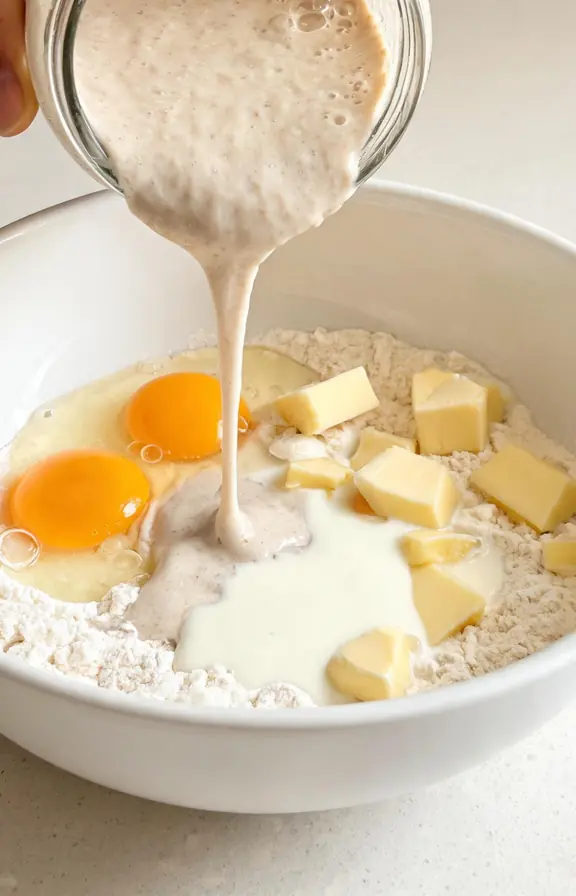
Here is a simple rule: For every 100g of 100% hydration discard you add, subtract 50g of flour and 50g of liquid from your base recipe. If your discard is thicker, adjust accordingly.
Getting this calculation right before you mix means the difference between a dough that handles cleanly and one that sticks to every surface.
- 100% hydration discard (equal flour/water): Subtract equal parts flour and liquid
- 80% hydration discard (stiffer): Subtract slightly more flour than liquid
- 125% hydration discard (looser): Subtract slightly more liquid than flour
Proofing Visual Cues: What to Look for at Every Stage
The two biggest proofing mistakes with enriched discard doughs are under-proofing (dense, tight crumb) and over-proofing (collapsed structure, gummy interior). Temperature, not time, is the real variable you need to track.
During bulk fermentation, the dough should increase by 50 to 75 percent in volume. At 75°F room temperature, this takes approximately 90 minutes. In a colder kitchen at 65°F, it can take 3 hours. Do not rely on a timer. Watch the dough.
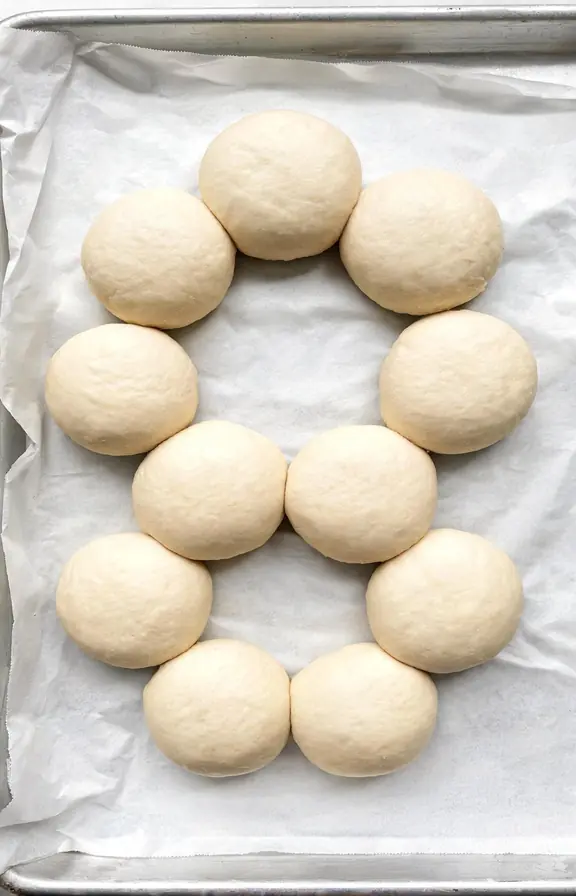
After shaping, the buns should look visibly puffier, feel light when you pick up the tray, and pass the poke test: press gently with one finger and the indent should spring back slowly, not immediately.
If it springs back instantly, they need more time. If it does not spring back at all, they are over-proofed.
Shaping Buns That Hold Their Height During Baking
Flat burger buns are a shaping problem, not a recipe problem. The shape you build before the final proof determines whether your bun comes out of the oven with a dome or a pancake.
Divide your dough into 8 equal pieces by weight, not by eye. Use a kitchen scale. Uneven pieces proof at different rates and bake unevenly.
For each piece, flatten it gently, fold the edges toward the center like an envelope, then flip it seam-side down onto an unfloured surface.
Cup your hand over the dough and use a circular motion to drag it toward you while keeping light pressure downward. This creates surface tension on the exterior of the bun that holds its dome during the final proof and in the oven.
Place shaped buns on a parchment-lined sheet pan with at least 2 inches of space between them. They will expand during the final proof. If they touch before baking, they will merge and pull apart unevenly when served.
Getting your baking surface right matters as much as your shaping technique. A heavy-gauge pan distributes heat evenly across the base of the buns.
Sheet Pan vs. Cast Iron: Which Surface Bakes Softer Buns
This comparison does not appear in any competitor recipe, and it changes the outcome significantly.
A light aluminum sheet pan transfers heat quickly and evenly to the base of the buns. This produces a thin, soft bottom crust that does not compete with the burger fillings above it. It is the right choice for soft sandwich-style buns.
A cast iron skillet or griddle holds and radiates intense, sustained heat from below. This produces a slightly thicker, crispier base with more color on the bottom.
If you are building a smash burger where the bun needs to hold against juicy, sauced patties without going soggy, cast iron is the better surface.
For this recipe, a rimmed aluminum sheet pan is recommended for the softest result.
If you prefer a sturdier bun, preheat a cast iron pan in the oven and transfer your shaped buns onto it just before baking. The burst of bottom heat also gives the buns better oven spring in the first five minutes.
Egg Wash, Seeds, and Finish: Getting the Professional Bakery Look
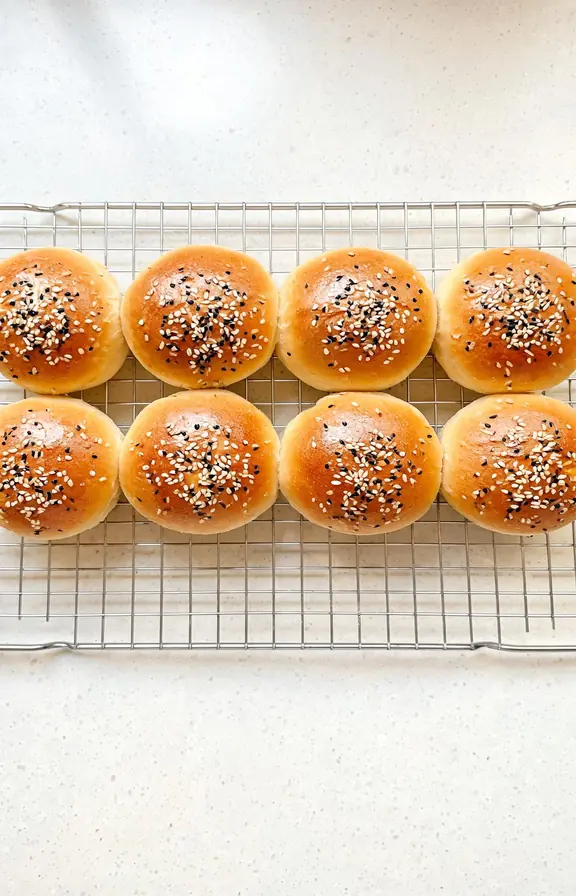
The egg wash is not cosmetic. It seals the surface of the bun and creates the glossy, deep-golden finish that signals softness to anyone looking at the plate.
Use one large egg mixed with one tablespoon of whole milk. The milk dilutes the egg slightly and prevents the wash from browning too fast before the interior is cooked through.
Apply with a soft pastry brush in one smooth pass just before the buns go in the oven. Do not let the wash pool in the creases of the bun or it will bake into a greasy patch.
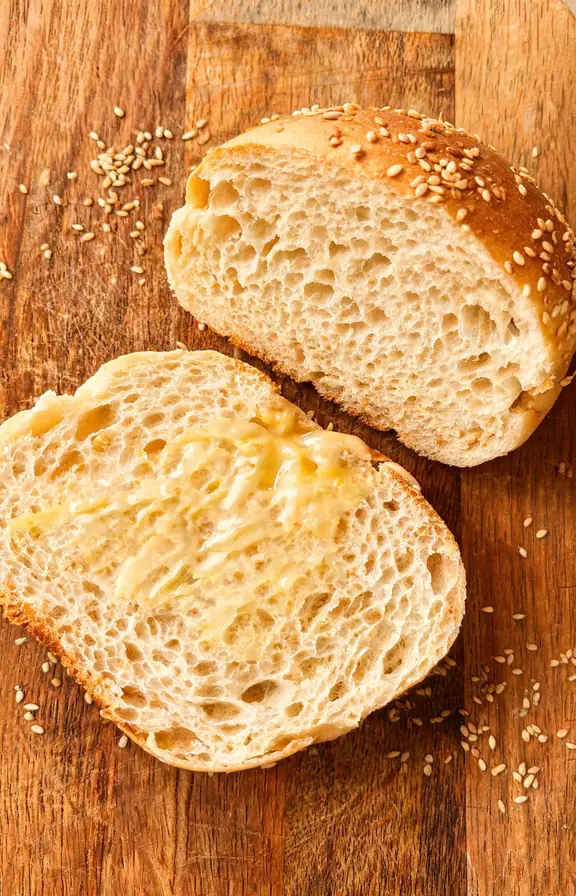
Sesame seeds are traditional, but everything bagel seasoning, flaky salt, or poppy seeds all work on this dough. Press the seeds gently into the egg wash immediately after brushing so they adhere through baking.
According to sources, a whole-egg-and-milk wash produces more even browning than an egg-yolk-only wash, which browns faster but can streak on soft enriched doughs.
How to Freeze and Reheat Sourdough Discard Hamburger Buns
These buns freeze exceptionally well, which makes them a genuinely practical no-waste baking project.
Cool the buns completely on a wire rack before freezing. This takes at least one hour. Buns that go into a freezer bag warm will steam and develop a gummy interior when thawed.
Wrap each bun individually in plastic wrap or press-and-seal film before placing them in a freezer bag. This prevents freezer burn on the surface and keeps the sesame seeds intact. Freeze for up to three months.
To reheat, place frozen buns directly into a 300°F oven for 12 minutes without unwrapping. The steam trapped inside the wrap during reheating mimics the steam of the original bake and restores the soft, pillowy texture.
Alternatively, split a frozen bun and toast it cut-side-down in a dry skillet over medium heat for 3 minutes. The interior warms through while the cut surface develops a light, buttery crust.
Frequently Asked Questions
Soft Sourdough Discard Hamburger Buns
Pillowy, golden-topped burger buns made with sourdough discard and a tangzhong paste. Hybrid yeast method gives reliable rise every time. Works with fresh or older discard. Freezer-friendly for zero-waste baking.
- Small saucepan (for tangzhong)
- Large mixing bowl or stand mixer with dough hook
- Kitchen scale (essential for accurate discard measurement)
- Rimmed baking sheet
- Parchment paper
- Pastry brush (for egg wash)
- Bench scraper
- Plastic wrap or damp towel (for covering dough)
- 2 tablespoons (16g) bread flour or all-purpose flour
- 6 tablespoons (90ml) whole milk
- 150g sourdough discard, room temperature (100% hydration)
- 120ml (1/2 cup) whole milk, warmed to 100°F
- 2 teaspoons (6g) instant yeast
- 2 tablespoons (25g) granulated sugar
- 1 large egg, room temperature
- 3 tablespoons (42g) unsalted butter, softened
- 300g (2 1/2 cups) bread flour, plus extra for dusting
- 1 teaspoon (6g) fine sea salt
- All of the tangzhong paste (from above)
- 1 large egg
- 1 tablespoon whole milk
- 2 tablespoons sesame seeds or everything bagel seasoning (optional)
- Make the tangzhong paste Whisk 2 tablespoons of flour with 6 tablespoons of milk in a small saucepan over low heat. Stir constantly for 3 to 4 minutes until the mixture thickens into a paste that holds a line when you drag a spoon through it. It should reach approximately 149°F if you are using a thermometer. Remove from heat and allow to cool to room temperature before adding to the dough. Do not skip this step. It is what makes these buns stay soft for days.
- Activate the yeast Combine the warmed milk, instant yeast, and sugar in your large mixing bowl. Stir briefly and let stand for 5 minutes until slightly foamy. This confirms the yeast is active. If there is no foam after 8 minutes, your yeast is old. Start with fresh yeast before proceeding.
- Build the dough Add the sourdough discard, egg, softened butter, cooled tangzhong paste, and salt to the yeast mixture. Stir to combine. Add the bread flour gradually, mixing until a shaggy dough forms. If mixing by hand, turn out onto a lightly floured surface and knead for 10 to 12 minutes until the dough is smooth, elastic, and slightly tacky but not sticky. If using a stand mixer, knead with the dough hook on medium speed for 7 minutes. The dough should clear the sides of the bowl but stick slightly to the bottom.
- Bulk fermentation Shape the dough into a ball, place in a lightly oiled bowl, and cover with plastic wrap or a damp towel. Allow to rise at room temperature until increased by 50 to 75 percent in volume. At 75°F this takes approximately 90 minutes. In a cooler kitchen, allow up to 3 hours. Watch the dough, not the clock.
- Divide and shape Turn the risen dough out onto a lightly floured surface. Divide into 8 equal pieces by weight using a kitchen scale. For each piece, flatten gently, fold edges toward the center, then flip seam-side down. Cup your hand over the piece and use a circular dragging motion against the surface to build surface tension and create a smooth dome. Place shaped buns on a parchment-lined baking sheet at least 2 inches apart.
- Final proof Cover loosely with oiled plastic wrap and allow to proof until visibly puffed and passing the poke test: press gently with one finger and the indent should spring back slowly over 3 to 4 seconds. At room temperature this takes 60 to 90 minutes. Preheat the oven to 375°F (190°C) during the last 30 minutes of this proof.
- Apply egg wash and bake Whisk together the egg and tablespoon of milk. Brush each bun gently with one smooth pass of egg wash. Sprinkle with sesame seeds if using, pressing them lightly into the surface. Bake at 375°F for 18 to 22 minutes until the tops are deep golden brown and the internal temperature reads 190°F to 195°F on an instant-read thermometer. The color should be even across the entire dome, not just the top center.
- Cool completely before slicing Transfer buns to a wire cooling rack immediately after removing from the oven. Allow to cool for at least 30 minutes before slicing. Cutting too early compresses the soft interior crumb and the buns will seem gummy. The tangzhong-enriched crumb continues to set as it cools.
Nutritional values are estimates calculated using standard USDA food composition data. Actual values will vary based on the hydration and age of your sourdough discard, specific flour brands used, and exact bun weight after baking.