Our site contains ads and uses Amazon affiliate links. We may earn a small commission at no extra cost to you. We know ads can be distracting, and we’re sorry for any inconvenience they cause. It helps us keep the site running. Thanks for your understanding and supporting us!
Most blueberry mousse cake recipes have the same two failure points. Either the mousse sets too stiff because the gelatin ratio is off, giving you something closer to Jell-O than a cloud-like filling.
Or the whole berries sink straight to the bottom, turning the layers you carefully built into one collapsed purple mass.
Both problems are solved by understanding two things: how gelatin behaves at different temperatures and why mousse needs to be poured at the right moment.
This recipe solves both. It uses a buttermilk sponge base for a tender, moist bottom layer that stays soft even after a night in the fridge. The mousse itself is built with a cooked blueberry puree that drives real fruit intensity into every bite, not just a blue tint from fold-in jam.
Why a Cooked Blueberry Puree Makes a Better Mousse Than Store-Bought Jam
Raw blueberries blended into whipped cream release too much water. That water weakens the foam structure and prevents the mousse from setting cleanly.
Cooking the berries first drives off excess moisture and concentrates the anthocyanin pigments that give blueberries their deep, vivid color.
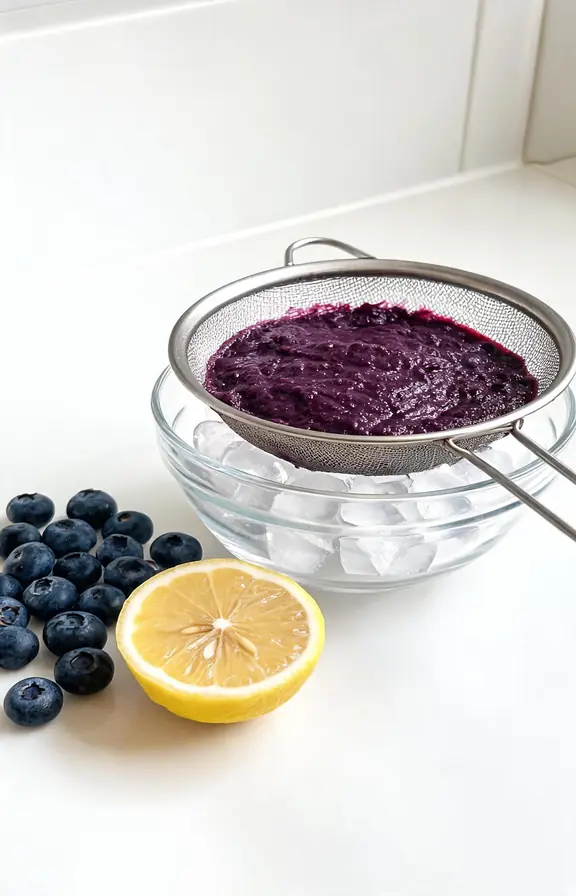
A short cook of 6 to 8 minutes with lemon juice and a small amount of sugar is enough. You are not making jam. You are collapsing the cell walls just enough to extract the juice cleanly before straining.
Straining through a fine-mesh sieve removes all skins and seeds. This step is the difference between a mousse with a silky, uniform texture and one that feels gritty when it hits your tongue.
According to research on dark-colored fruits, cooking blueberries actually preserves and concentrates their anthocyanin content better than consuming them raw in many applications, making your mousse both more colorful and more nutrient-dense.
How Gelatin Sets a Fruit Mousse Without Turning It Rubbery
Gelatin concentration is everything in a mousse cake. Too little and the layers collapse when you unmold. Too much and you end up slicing through something that bounces back at the knife.
The correct ratio for a sliceable but still airy mousse is 1 teaspoon (about 3.5g) of powdered unflavored gelatin per 1.5 cups of whipped cream. This recipe uses exactly that ratio scaled to a 9-inch springform pan.
Blooming gelatin is non-negotiable. Sprinkle it over cold water, never hot, and let it sit undisturbed for 5 minutes. The granules will absorb the water and swell into a soft, spongy mass.
Then warm it gently, either in a small saucepan over low heat or in 10-second microwave bursts, until it liquefies completely. Add it to your cooled blueberry puree, not directly to the cream.
Whisking gelatin into warm puree distributes it evenly before the fat in the cream has any chance to interfere with setting.
The Three-Layer Staging Method: How Whole Berries Stay Suspended
Every blueberry mousse cake recipe that tells you to mix whole berries into the full batch of mousse and pour it all at once is setting you up for sinking fruit. Berries are denser than mousse. Gravity wins. They fall.
The staged method fixes this completely. Divide your mousse into three equal portions. Pour the first third into the springform pan over your chilled crust.
Arrange a single layer of fresh blueberries across the surface, pressing each one halfway into the mousse. Refrigerate for 15 to 20 minutes until that layer is just set enough to hold the berries in place.
Add the second portion of mousse. Repeat the berry grid. Chill again. Then add the final layer and smooth the top with an offset spatula.
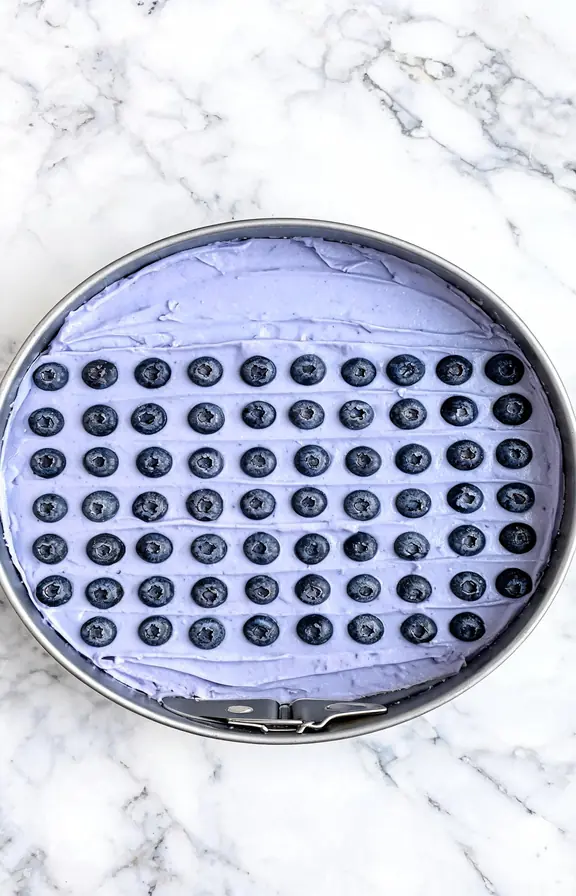
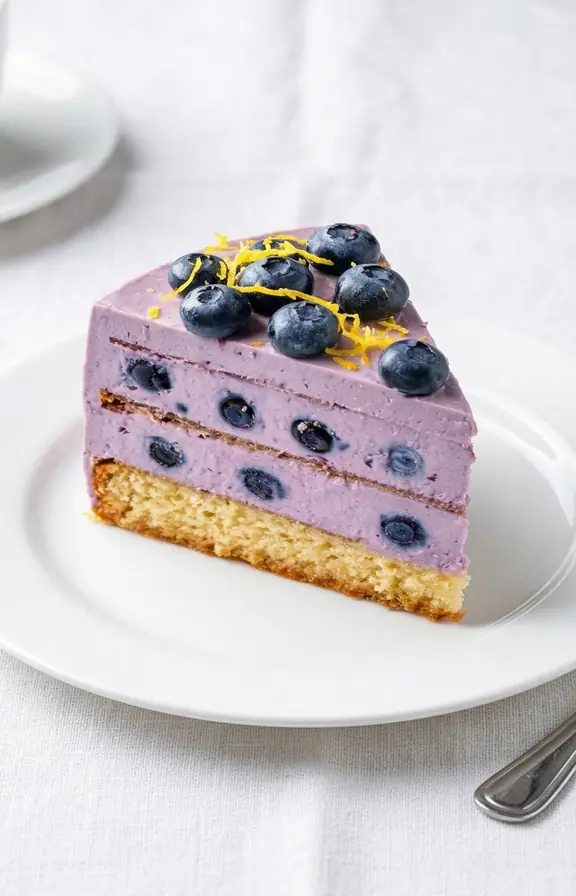
This gives you three distinct mousse layers with two suspended berry layers visible in every slice. The chilling between stages also allows each layer to firm slightly before the weight of the next presses down on it.
The result is a cake that holds its height, shows clean layers, and delivers a whole berry in almost every forkful.
If you enjoy building structured fruit desserts like this, our bright, silky blueberry curd made for cake fillings uses a similar layering approach with even more concentrated blueberry flavor.
Choosing the Right Crust: Graham Cracker vs. Digestive Biscuit vs. Baked Sponge
Most blueberry mousse cake recipes default to a graham cracker crust. That is a fine choice, but it is not the only one, and each base changes the final eating experience significantly.
A graham cracker crust gives you a mild sweetness and a sandy crunch that contrasts nicely with the airy mousse above it.
It is the fastest option and requires no baking. Press it firmly into the bottom of the pan with the bottom of a measuring cup to prevent crumbling when you slice.
Digestive biscuits produce a slightly more caramelized, butterscotch-adjacent flavor. They also bind together with less butter than graham crackers, making the crust slightly firmer.
A baked buttermilk sponge base is the most sophisticated choice and the one used in this recipe.
It adds a soft, moist foundation that absorbs a small amount of blueberry moisture from the mousse and creates a distinct textural shift from cake base to creamy middle to fruit-dotted top.
If you want to understand how to build a light, stable whipped cream layer on top of a cake base like this, our guide to making a whipped cream frosting that holds its shape all day covers the stabilization techniques that apply here too.
Fresh vs. Frozen Blueberries: Which Produces Better Mousse
For the cooked puree base of the mousse, frozen blueberries are actually the better choice.
They are typically flash-frozen at peak ripeness and release more juice when cooked down than out-of-season fresh berries. More juice means a more intensely flavored puree and a deeper purple color in the finished mousse.
For the whole berries you press into each layer, fresh is essential. Frozen berries thaw and release water as the mousse chills, creating soft, watery pockets around each berry.
That moisture softens the surrounding mousse and can cause that layer to set unevenly. Fresh berries hold their shape and firmness through the full chilling period.
If you are making this outside blueberry season, use frozen for the puree and substitute another fresh berry for the suspended layer. Fresh raspberries or halved strawberries work beautifully and pair well with the blueberry mousse flavor.
Frequently Asked Questions
Blueberry Mousse Cake
Light, silky blueberry mousse built in three chilled stages over a soft buttermilk sponge base. Whole berries stay suspended in every layer. Deep blueberry flavor from a cooked, strained puree. Make-ahead and freezer-friendly.
- 9-inch springform pan
- Fine-mesh sieve (for straining blueberry puree)
- Stand mixer or hand mixer
- Medium saucepan
- Offset spatula
- Mixing bowls (at least 3)
- Kitchen scale
- Rubber spatula
- Instant-read thermometer (optional but helpful)
- 120g (1 cup) all-purpose flour
- 150g (3/4 cup) granulated sugar
- 1 teaspoon baking powder
- 1/4 teaspoon baking soda
- 1/4 teaspoon fine sea salt
- 2 large eggs, room temperature
- 120ml (1/2 cup) buttermilk, room temperature
- 60ml (1/4 cup) neutral oil (canola or sunflower)
- 1 teaspoon pure vanilla extract
- 400g (2 3/4 cups) fresh or frozen blueberries, for the puree
- 3 tablespoons (38g) granulated sugar
- 1 tablespoon fresh lemon juice
- 2 1/4 teaspoons (7g) unflavored powdered gelatin
- 3 tablespoons (45ml) cold water (for blooming gelatin)
- 480ml (2 cups) heavy whipping cream, very cold
- 3 tablespoons (22g) powdered sugar
- 1 teaspoon pure vanilla extract
- 200g (1 1/2 cups) fresh blueberries, for layering and topping
- Fresh mint leaves (optional garnish)
- Lemon zest for finishing (optional)
- Bake the sponge base Preheat your oven to 350°F (175°C). Grease the bottom of a 9-inch springform pan and line it with parchment paper. Whisk together flour, sugar, baking powder, baking soda, and salt in a large bowl. In a separate bowl, whisk the eggs, buttermilk, oil, and vanilla until smooth. Pour the wet ingredients into the dry and mix until just combined. Do not overmix. Pour into the prepared pan and bake for 18 to 22 minutes until a toothpick inserted in the center comes out clean. Cool completely in the pan on a wire rack before adding the mousse. If the sponge domes, level it with a serrated knife so the mousse layers sit evenly.
- Cook and strain the blueberry puree Combine the 400g blueberries, granulated sugar, and lemon juice in a medium saucepan over medium heat. Cook, stirring occasionally, for 6 to 8 minutes until the berries collapse and release their juice and the mixture reduces slightly. Pour through a fine-mesh sieve into a bowl, pressing firmly with a spoon to extract as much juice and pulp as possible. Discard the skins. You should have about 240ml (1 cup) of smooth, deep-purple puree. Set the bowl over an ice bath and stir until the puree reaches refrigerator temperature, about 15 minutes.
- Bloom and dissolve the gelatin Sprinkle the powdered gelatin evenly over the 3 tablespoons of cold water in a small bowl. Do not stir. Let it sit undisturbed for 5 minutes until the granules swell and absorb all the water. Then warm the bloomed gelatin in 10-second microwave bursts, stirring after each, until it becomes completely liquid and clear with no visible granules. Immediately whisk this liquid gelatin into your cold blueberry puree until fully incorporated. The puree must be cold when you do this. If it is still warm, the gelatin sets unevenly.
- Whip the cream and build the mousse Pour the cold heavy cream into a chilled mixing bowl. Add the powdered sugar and vanilla. Beat on medium-high speed until the cream holds firm peaks that stand straight up when you lift the beater. The peaks should not curl over or droop. Fold one-third of the whipped cream into the blueberry-gelatin puree using a rubber spatula and broad sweeping motions to lighten the mixture. Then gently fold in the remaining cream in two additions until no white streaks remain and the mousse is a uniform, vivid purple. Work quickly but gently to preserve as much air as possible.
- Layer the mousse with suspended blueberries Divide the mousse into three equal portions. Pour the first portion over the cooled sponge base and spread into an even layer with your offset spatula. Arrange a single layer of fresh whole blueberries across the surface in rows, pressing each berry halfway into the mousse. Refrigerate for 20 minutes until that layer is just firm enough to hold the berries. Add the second mousse portion, smooth it, and repeat the berry layer. Chill again for 20 minutes. Pour the final mousse portion over the top and smooth it perfectly flat. Cover the pan tightly with plastic wrap and refrigerate for at least 6 hours, or overnight.
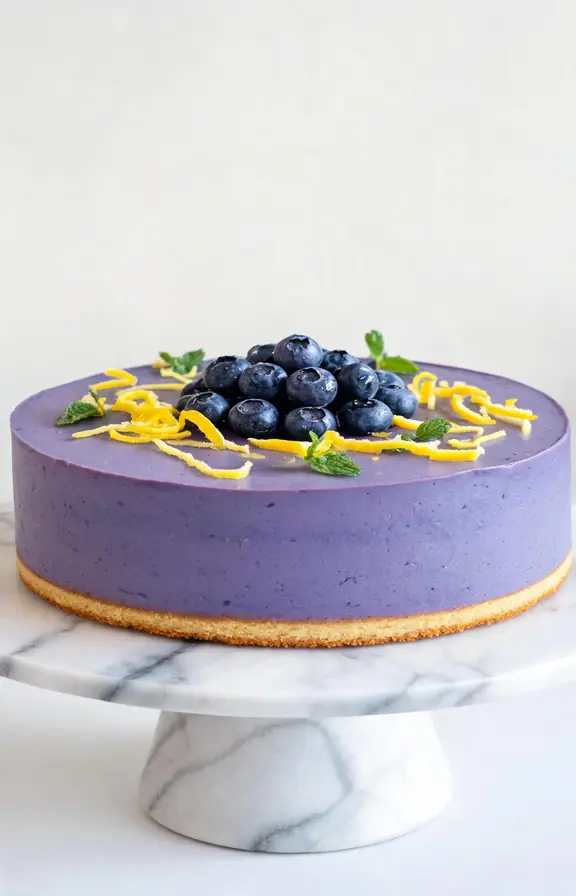
- Unmold and garnish Run a thin knife around the inside edge of the springform pan before releasing the latch. If the mousse clings to the sides, wrap a warm damp towel around the exterior of the pan for 30 seconds. This gently warms the sides and releases the mousse cleanly. Place the cake on a serving plate and top with fresh blueberries, a grating of lemon zest, and mint leaves if using. Slice with a sharp thin knife dipped in hot water and wiped dry between each cut. Serve immediately or refrigerate uncovered for up to 30 minutes before serving.
Nutritional values are estimates calculated using standard USDA food composition data. Actual values will vary based on the brand of cream used, ripeness of blueberries, and exact serving size.