Our site contains ads and uses Amazon affiliate links. We may earn a small commission at no extra cost to you. We know ads can be distracting, and we’re sorry for any inconvenience they cause. It helps us keep the site running. Thanks for your understanding and supporting us!
Most no bake cookie recipes produce a soft, sticky mess that never quite firms up the way you expected.
The reason is almost always the same: the wrong oat type, the wrong peanut butter, or a setting method that was never fully explained in the recipe.
This article fixes that. You will get the full recipe, the science behind why these cookies set without an oven, and a troubleshooting guide that covers every reason they could go wrong.
No baking experience needed. No mixer, no thermometer, no special equipment. Just a saucepan, a bowl, and a spoon.
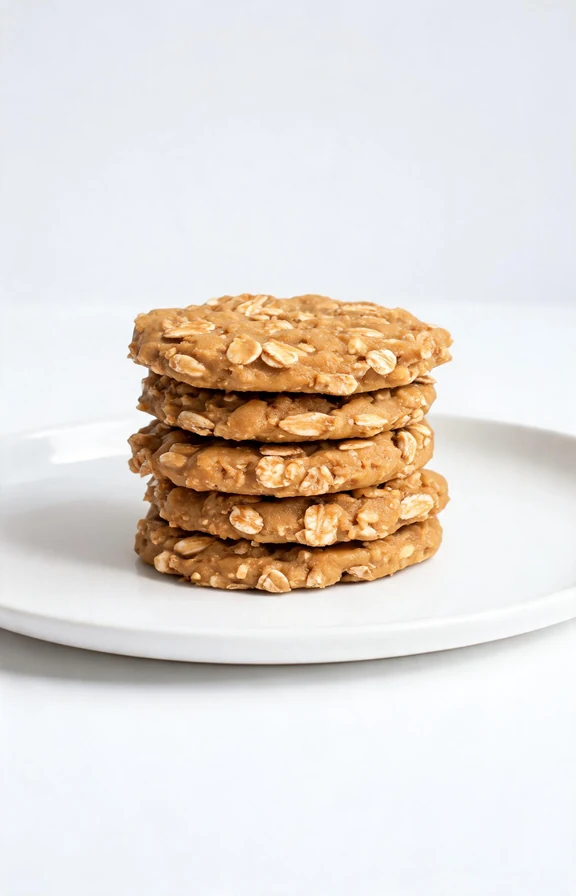
Why These 4 Ingredients Work (The Science Behind No Bake Cookies)
Every ingredient in this recipe is doing structural work. Understanding that makes it easier to troubleshoot when something goes wrong.
Peanut butter is the primary fat and protein source. At room temperature, the fat in peanut butter is semi-solid. When warmed and cooled, it transitions through a liquid state and then re-solidifies in the shape of the scoop. This is the core setting mechanism in the no-boil version of this recipe.
Honey or maple syrup provides two things: sweetness and hygroscopic binding. Honey draws moisture from the air and holds ingredients together. It also creates a sticky matrix around the oats so they do not crumble apart after chilling.
Quick oats provide the bulk and chew. They also absorb liquid from the peanut butter and sweetener, which tightens the mixture as it cools. Old fashioned oats absorb liquid more slowly and produce a harder, less unified texture in a no-bake cookie.
Salt is the fourth ingredient, and it is not optional for flavor. Salt suppresses bitterness in the peanut butter and amplifies the sweetness of the honey without adding more sugar.
Two Setting Methods: Refrigerator vs. Stovetop Boil
There are two distinct recipes that both go by the name “no bake peanut butter oatmeal cookies.” They set by completely different mechanisms and produce different textures.
Method 1: Refrigerator-Set (This Recipe)
Peanut butter is warmed gently. Honey is stirred in. Quick oats and salt are folded through. The mixture is scooped and chilled. Setting happens because the peanut butter fat cools from a semi-fluid state into a firm mass around the oats.
The texture is softer and chewier. The cookies stay refrigerator-dependent, meaning they soften quickly at room temperature above 75 degrees Fahrenheit. This method needs no thermometer, no precise timing, and no cooking experience.
Method 2: Stovetop Sugar-Set (Classic No Bake Cookie)
Sugar, butter, and milk are boiled together to approximately 230 degrees Fahrenheit, which is the soft ball stage of sugar cookery. Peanut butter and oats are stirred in. The cookies set because the sugar crystallizes as it cools, creating a firm candy-like matrix.
This method produces a cookie that holds at room temperature for several days. The trade-off is that it requires precision. Boil too short and the cookies will not set. Boil too long and they turn grainy and crumbly from over-crystallized sugar.
This article covers Method 1 in full. If you want to try the stovetop version, our No Bake Peanut Butter S’mores Bars use a similar stovetop technique with a more forgiving ratio.
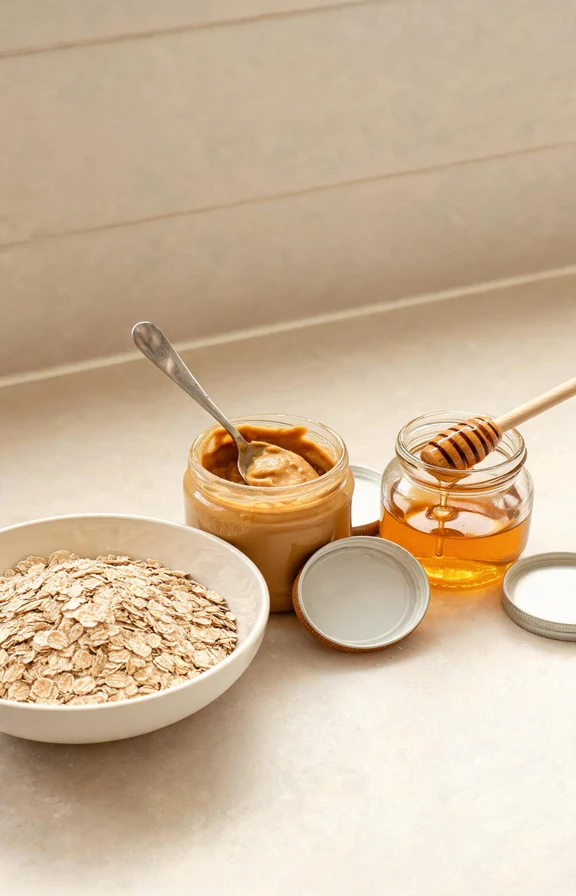
The Fat-to-Oat Ratio Rule That Most Recipes Get Wrong
The most common structural failure in no bake cookies is using too many oats relative to the fat content.
Peanut butter is approximately 50 percent fat by weight. For every one cup of peanut butter (roughly 258 grams), you need no more than 1.5 cups of quick oats for the mixture to hold together after chilling.
More oats than that and the fat cannot fully coat every oat particle. The result is a crumbly cookie that falls apart when picked up.
The correct ratio for a refrigerator-set no bake cookie is approximately 1:0.6 by weight (peanut butter to oats). This recipe uses exactly that ratio.
Honey adds a small amount of additional binding force. But it cannot compensate for a fat deficit. If you want to add more oats for a denser, more filling cookie, compensate by adding one additional tablespoon of peanut butter per extra quarter cup of oats.
Honey vs. Maple Syrup: Binding Behavior Compared
Honey and maple syrup are often listed as interchangeable in this recipe. They are not fully equivalent in binding behavior, even though both work.
Honey has a higher viscosity and a higher sugar content per tablespoon than maple syrup. It creates a slightly stickier, denser matrix around the oats. Cookies made with honey hold together at slightly higher temperatures before softening.
Maple syrup has a thinner consistency and a lower sugar density. The cookies set just as well in the refrigerator, but they soften faster at room temperature and have a slightly less chewy texture.
For the firmest cookies that hold longest outside the fridge, use honey. For a lighter sweetness with a subtler flavor that does not compete with the peanut butter, use maple syrup.
Do not use agave nectar as a substitute. Agave has very low viscosity and high fructose content. It does not provide the same binding adhesion, and cookies made with it tend to stay tacky rather than firm even after extended chilling.
Texture Variations: What Changes When You Adjust Each Ingredient
Add-In Combinations That Work Without Changing the Set
The base recipe is designed to set reliably with exactly four ingredients. Every add-in risks disrupting that balance if added in too large a quantity.
These add-ins stay under the threshold that would affect setting. Add any one of them in the quantity listed.
Mini chocolate chips (3 tablespoons): Fold in after mixing, just before scooping. Do not heat the chips into the mixture or the chocolate will thin the fat content and slow setting.
Flaxseed meal (1 tablespoon): Adds fiber without changing texture noticeably. Flaxseed also absorbs moisture and slightly tightens the mixture, which can help cookies set faster.
Vanilla extract (1/2 teaspoon): Does not affect structure. Adds a warm aromatic depth that rounds out the peanut butter flavor. Use pure vanilla, not imitation.
Cinnamon (1/4 teaspoon): Pairs well with the oat and honey flavor. Does not affect setting.
If you enjoy peanut butter and chocolate together, our Chocolate Peanut Butter Brownie Pie and the Keto Chocolate Peanut Butter Bars use the same flavor combination in a baked format if you prefer a firmer, room-temperature-stable treat.
Humidity Troubleshooting: Why Your Cookies May Not Set in Summer
High ambient humidity is the most common environmental reason no bake cookies fail to set properly.
Honey is hygroscopic, meaning it actively pulls moisture from the surrounding air. In humid conditions above 60 percent relative humidity, honey absorbs enough ambient moisture to stay sticky rather than setting into a firm matrix.
There are three fixes for this.
First, chill the cookies immediately after scooping. Do not leave them on the counter to cool to room temperature first. Get them into the refrigerator within five minutes of scooping.
Second, use a slightly higher honey ratio and a slightly lower peanut butter temperature. Warmer peanut butter thins the mixture and slows setting. Heat the peanut butter just enough to stir it smooth, not until it is fully liquid.
Third, store the finished cookies with the lid slightly ajar for the first 30 minutes in the refrigerator. This allows surface moisture to escape before sealing the container. Once set and firm, seal completely.
For a related no-oven treat that holds at room temperature regardless of humidity, see our No Bake Strawberry Cheesecake Bars which use a different setting mechanism based on cream cheese and gelatin.
Make-Ahead and Storage Guide
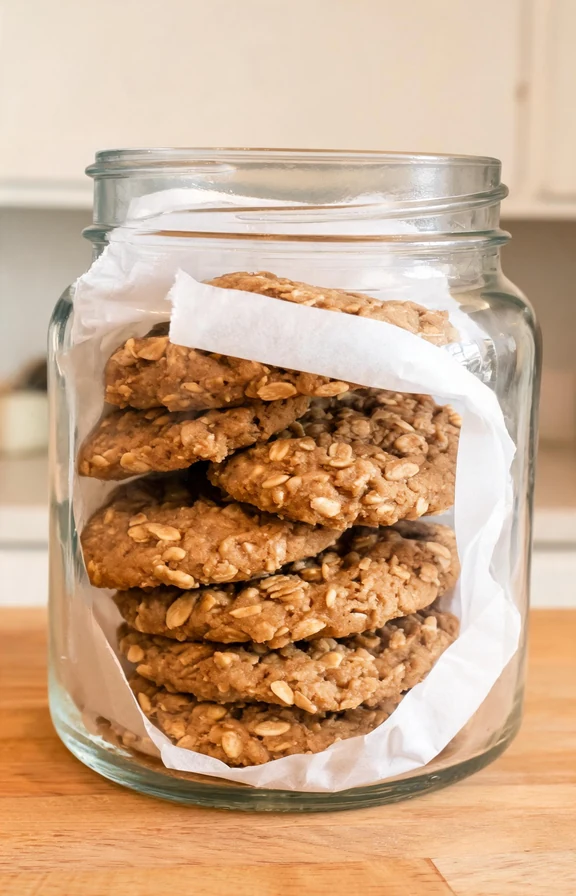
These cookies store in the refrigerator for up to 7 days in an airtight glass container. Layer them between sheets of parchment paper to prevent sticking.
For longer storage, freeze them. Arrange on a parchment-lined baking sheet, freeze solid for one hour, then transfer to a freezer-safe zip bag. Frozen cookies keep for up to 2 months. Thaw in the refrigerator for 30 minutes before serving.
Do not store at room temperature above 72 degrees Fahrenheit. The peanut butter fat softens and the cookies lose their structure. If your kitchen runs warm, always keep them refrigerated and serve cold.
For batch baking during meal prep, this recipe doubles and triples without any adjustment to ratios or chill time. A double batch fits on one large parchment-lined sheet pan in the refrigerator.
Frequently Asked Questions
4 Ingredients Peanut Butter Oatmeal No Bake Cookies
Soft and chewy no bake cookies made with just peanut butter, quick oats, honey, and salt. Ready in 30 minutes with zero oven time. Refrigerator-set method that works every time.
- Small saucepan or microwave-safe bowl
- Large mixing bowl
- Silicone spatula or wooden spoon
- Cookie scoop (1.5 tablespoon size) or two spoons
- Parchment paper or silicone baking mat
- Flat plate or small baking sheet
- Measuring cups and spoons
- 1 cup (258g) commercial creamy peanut butter (Jif, Skippy, or similar), not natural
- 1/3 cup (113g) honey (or pure maple syrup for vegan)
- 1 1/2 cups (135g) quick oats (not old fashioned, not instant)
- 1/4 teaspoon fine sea salt
- 3 tablespoons mini chocolate chips
- 1/2 teaspoon pure vanilla extract
- 1 tablespoon flaxseed meal
- 1/4 teaspoon ground cinnamon
- Prep your parchment Line a flat plate or small baking sheet with parchment paper or a silicone mat. Set it near the stove so you can scoop cookies quickly once the mixture is warm. Have your cookie scoop ready.
- Warm the peanut butter and honey In a small saucepan over low heat, combine the peanut butter and honey. Stir continuously for 2 to 3 minutes until fully combined and smooth. The mixture should be warm and pourable but not bubbling or steaming. Do not let it boil. Alternatively, microwave in a large mixing bowl in 20-second bursts, stirring between each, until smooth and warm, about 40 to 60 seconds total.
- Add the oats and salt Remove the saucepan from heat. Add the quick oats, salt, and any optional add-ins (except chocolate chips) directly into the warm mixture. Stir with a spatula until every oat is coated. The mixture will thicken quickly as the oats absorb the fat. If using chocolate chips, fold them in last, after the oats are fully incorporated, to prevent melting.
- Scoop immediately Working quickly while the mixture is still warm and pliable, use a 1.5 tablespoon cookie scoop to drop rounds onto the parchment-lined surface. If you do not have a scoop, use two spoons to form mounds. Press each mound slightly flat with your fingers or the back of a spoon. Space them about an inch apart. The mixture firms as it cools so scoop all cookies within 3 to 4 minutes of mixing.
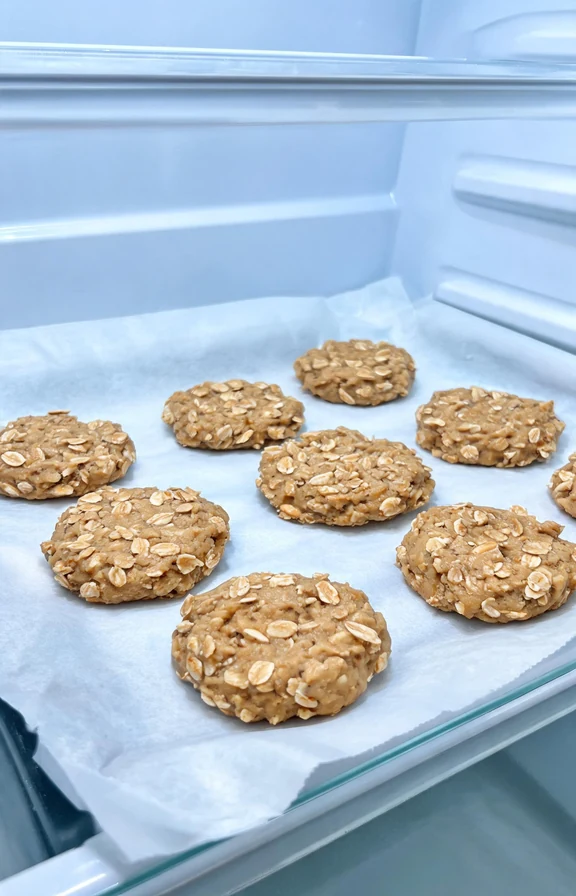
- Refrigerate to set Place the plate or sheet directly into the refrigerator uncovered. Chill for at least 20 minutes until the cookies are firm and hold their shape when lifted. In humid conditions, chill for 35 to 45 minutes. Do not leave the cookies on the counter to set at room temperature. The refrigerator is what triggers the peanut butter fat to solidify.
- Store and serve Transfer set cookies to an airtight glass container, layering between sheets of parchment paper. Refrigerate for up to 7 days. Serve cold or at cool room temperature. These cookies soften above 72 degrees Fahrenheit, so do not leave them out at warm room temperature for more than 30 minutes.
Nutritional values are estimates calculated using standard USDA food data for commercial creamy peanut butter, quick oats, and honey. Actual values may vary based on specific ingredient brands, scoop size, and any add-ins used. For verified nutritional information, use a dedicated nutrition calculator with your exact ingredient brands and weights.