Our site contains ads and uses Amazon affiliate links. We may earn a small commission at no extra cost to you. We know ads can be distracting, and we’re sorry for any inconvenience they cause. It helps us keep the site running. Thanks for your understanding and supporting us!
Most lemon tiramisu recipes fail at the same two moments: the mascarpone splits when the lemon curd is added too warm, or the ladyfingers turn to mush because nobody explains how long “a quick dip” actually is.
This recipe fixes both problems with food science, not guesswork.
You will also find the one step every top-ten competitor skips: why you must use a non-metal bowl when working with lemon, and exactly what happens to your filling if you do not.
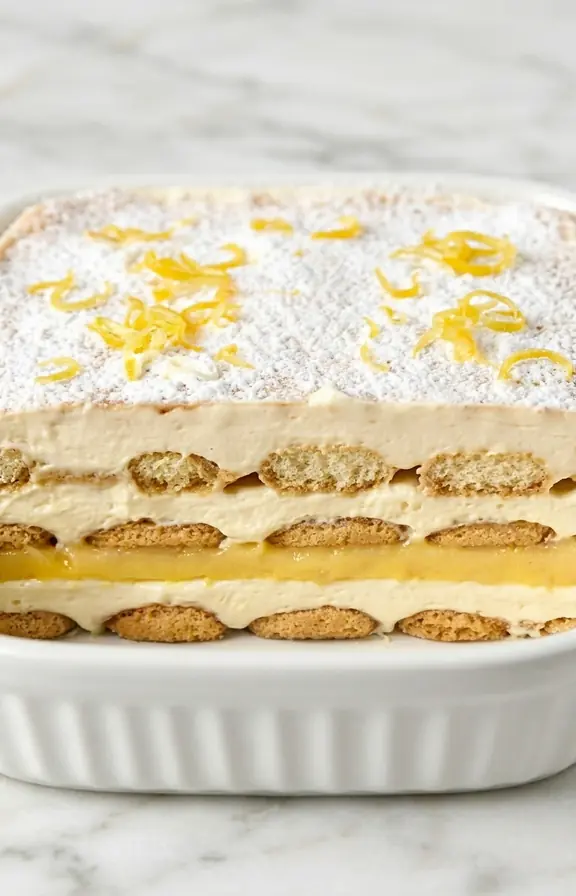
Why Lemon Tiramisu Splits (and How to Stop It)
Lemon juice is acidic, and mascarpone is a fresh soft cheese made entirely from high-fat cream coagulated with acid. When you introduce more acid into already-coagulated cream proteins, the proteins clump further and squeeze out liquid.
That is the science behind a grainy, split filling. It is not a technique failure; it is a chemistry failure.
The fix is sequencing. You fold lemon curd into whipped cream first, then gently combine with mascarpone, never the reverse. And every component must be cold before it meets another.
According to food science research on dairy protein behavior, cold temperatures slow acid-induced protein aggregation dramatically, which is why a cold mascarpone filling stays smooth while a room-temperature one breaks.
The Non-Metal Bowl Rule Nobody Talks About
Every recipe in the top 10 for lemon tiramisu tells you to stir and mix without specifying bowl material. This one rule costs bakers the clean, bright citrus flavor they were after.
Lemon juice contains citric and ascorbic acids that react with reactive metals including aluminum, copper, and uncoated steel. The reaction produces metallic ions that leach into the food and give your curd and cream a faint but unmistakable metallic aftertaste.
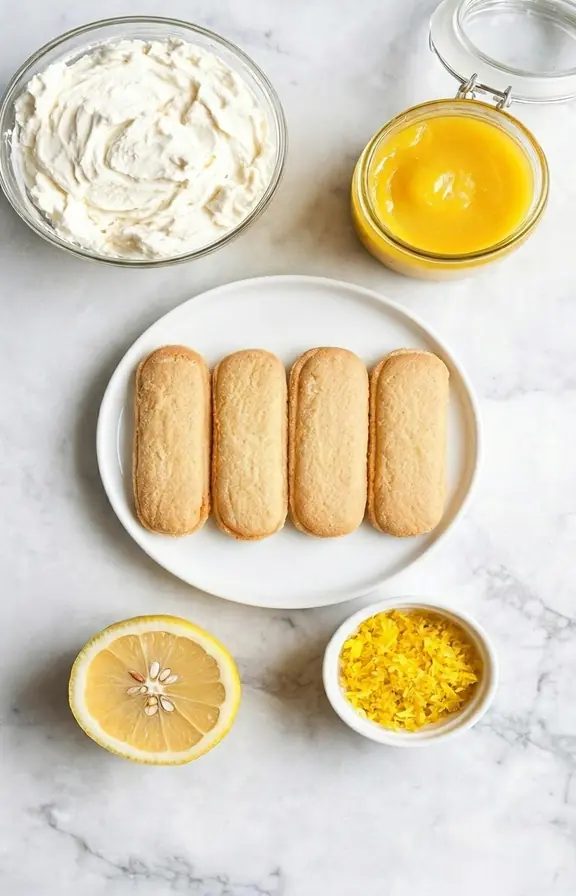
Use glass, stainless steel, ceramic, or food-safe silicone for every bowl and pan that touches lemon. This matters most during curd cooking, but also applies to your mixing bowl for the mascarpone cream.
The Ladyfinger Dip Window: 1 to 2 Seconds Only
Every recipe says “quickly dip the ladyfingers.” None of them define “quickly.”
Dry savoiardi ladyfingers absorb liquid through capillary action. The first 1-2 seconds pull syrup into the outer layer of the biscuit. After that, the syrup migrates inward by diffusion, which continues overnight in the fridge.
If you hold a ladyfinger in lemon syrup for 4-5 seconds, the outer structure is already saturated when you assemble. The continued migration during chilling creates a wet, structureless base layer with no distinct ladyfinger texture remaining.
Dip for 1 second per side, maximum. The ladyfingers will finish hydrating during the overnight chill and come out soft but distinct, exactly the texture a proper tiramisu should have.
- Dry savoiardi (the hard Italian kind): Ideal. They absorb precisely and hold structure through the chill.
- Soft ladyfingers (cake-style): They are already moist. A 1-second dip will over-saturate them. Skip the dip entirely and just brush with syrup using a pastry brush.
- Gluten-free ladyfingers: Treat like soft ladyfingers. They break down faster in liquid.
Lemon Curd: Homemade vs. Store-Bought
Homemade lemon curd takes 20-25 minutes over a bain marie and gives you control over tartness and thickness. Store-bought works but varies widely in pectin content, which affects how it layers without bleeding into the cream.
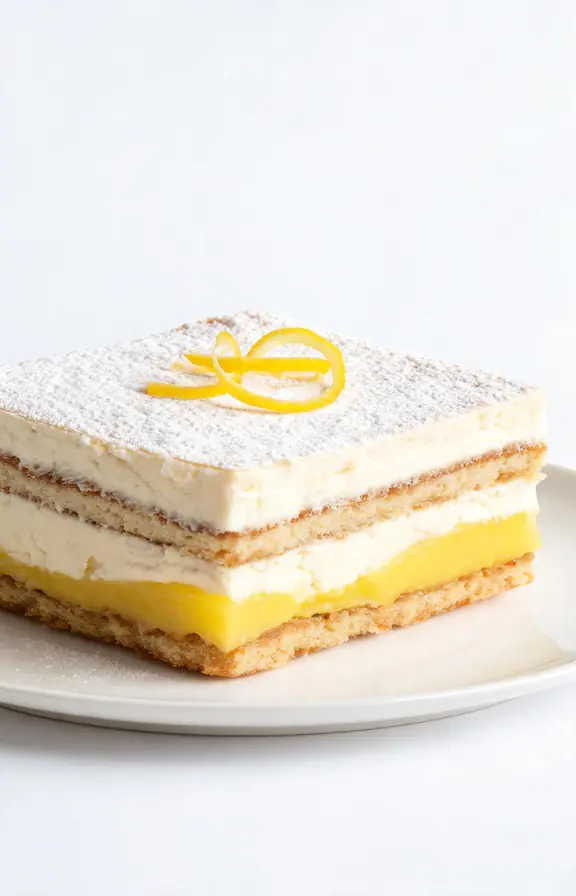
If you use store-bought curd, chill it to refrigerator temperature before spreading. Cold curd is thick enough to sit on top of the mascarpone cream without sinking in.
If you make your own, cook the curd until it coats the back of a spoon cleanly and a finger dragged across the spoon leaves a clear line. This is approximately 170-175°F (77-79°C) for whole-egg curd.
Under-cooked curd stays runny and bleeds into the cream layer below it, destroying the visual separation that makes this dessert impressive.
If you enjoy building desserts with a pastry cream base, our guide on how to make a stable lemon meringue pie filling that never weeps explains the same egg-thickening principles in more detail.
Chilling Time: Why 8 Hours Beats 2 Hours
Every recipe in this category says you can chill for “at least 2 hours.” That is technically true. The tiramisu will be edible at 2 hours but it will not be its best self.
During the first 2 hours, the ladyfingers hydrate and the filling firms. During hours 4 to 8, flavor compounds from the lemon syrup, curd, and mascarpone migrate across layers and merge into a single cohesive flavor profile.
This is the same principle behind aged wine or marinated meat: time allows smaller flavor molecules to travel where they belong.
An 8-hour chill (overnight) also allows the curd layer to set firmly enough that you can slice the tiramisu cleanly. At 2 hours, the curd is still soft and will smear when cut.

Limoncello vs. No Alcohol: Which Version Actually Works
Limoncello adds a distinct bitter-floral lemon note that does not come from juice or zest alone. It works beautifully in the soaking syrup because it slows ladyfinger absorption slightly, giving you a wider dipping window before over-saturation.
The alcohol also inhibits bacterial growth in the syrup, which is worth noting if you are serving this to a crowd after it has sat out for any length of time.
For an alcohol-free version, add 1 teaspoon of lemon extract to the syrup. It gives a concentrated lemon note closer to limoncello than plain juice alone. You can also use a non-alcoholic lemon syrup available at Italian specialty grocers.
Mascarpone Temperature: The One Variable That Controls Everything
Mascarpone must stay cold through every mixing step. The moment it warms above 65°F (18°C), the fat and water in the emulsion begin to separate. Overbeating at any temperature accelerates this breakdown.
Beat mascarpone only until just smooth: 15-20 seconds at medium speed. Then stop. Every additional second of beating past that point breaks the emulsion further.
For the best flavor base in a cream dessert, our article on getting a perfectly smooth Philadelphia no-bake cheesecake filling without lumps or graininess covers the same cold-mixing principles that apply directly to mascarpone work.
Frequently Asked Questions
Lemon Tiramisu with Lemon Curd
No-bake lemon tiramisu built on cold mascarpone cream, homemade lemon curd, and precisely dipped ladyfingers. No oven. No raw eggs in the filling. Slices cleanly after an overnight chill.
- 9×13 inch glass or ceramic baking dish
- Medium saucepan (stainless steel or ceramic-coated)
- Glass or stainless steel mixing bowls (no aluminum)
- Hand mixer or stand mixer
- Fine mesh sieve
- Whisk
- Silicone spatula
- Shallow bowl for dipping ladyfingers
- Instant-read thermometer (optional but recommended for curd)
- 4 large eggs
- 2 egg yolks
- 180ml (3/4 cup) freshly squeezed lemon juice (about 4-5 large lemons)
- 150g (3/4 cup) granulated sugar
- 1 tablespoon lemon zest
- Pinch of fine sea salt
- 85g (6 tablespoons) unsalted butter, cold and cubed
- 120ml (1/2 cup) freshly squeezed lemon juice
- 120ml (1/2 cup) water
- 100g (1/2 cup) granulated sugar
- 60ml (1/4 cup) limoncello, optional
- 450g (16 oz) mascarpone cheese, cold straight from the fridge
- 360ml (1.5 cups) cold heavy whipping cream
- 60g (1/2 cup) powdered sugar
- 1 teaspoon pure vanilla extract
- 1/4 teaspoon fine sea salt
- 300g (about 24-28 pieces) dry savoiardi ladyfingers
- 2 tablespoons powdered sugar, for dusting
- Zest of 1 lemon, for garnish
- Thin lemon slices, for garnish (optional)
- Make the lemon curd Combine eggs, egg yolks, lemon juice, sugar, zest, and salt in a stainless steel or glass bowl set over a saucepan of gently simmering water. The bowl must not touch the water. Whisk constantly over medium-low heat until the mixture thickens enough to coat the back of a spoon and a finger dragged across the spoon leaves a clean trail. This takes 20-25 minutes and should reach 170-175°F (77-79°C). Remove from heat and whisk in the cold cubed butter one piece at a time until fully melted and smooth. Pour through a fine mesh sieve into a clean glass or ceramic bowl. Press plastic wrap directly onto the surface and refrigerate for a minimum of 2 hours until fully cold and thick.
- Make the lemon soaking syrup Combine lemon juice, water, and sugar in a small stainless steel saucepan over medium heat. Stir until the sugar fully dissolves, about 3 minutes. Do not boil. Remove from heat. If using limoncello, stir it in now, off the heat. Transfer to a shallow bowl and cool to room temperature, then refrigerate until cold. The syrup must be cold before dipping to prevent warming the ladyfingers and accelerating over-absorption.
- Make the mascarpone cream Keep mascarpone in the fridge until the moment you need it. In a cold glass or stainless steel bowl, beat the cold heavy cream, powdered sugar, vanilla, and salt with a hand mixer on medium-high speed until stiff peaks form. In a separate bowl, beat the cold mascarpone on medium speed for 15-20 seconds only, just until smooth. Do not overbeat. Gently fold the whipped cream into the mascarpone in three additions using a silicone spatula. Stop folding the moment no white streaks remain. The cream should be thick, smooth, and hold its shape without being stiff or grainy.
- Add lemon curd to cream Take 200g (about 3/4 cup) of the fully chilled lemon curd from the fridge. Gently fold it into the mascarpone cream in two additions until just combined. The cream will turn a pale, soft yellow with no visible curd streaks. Set aside the remaining lemon curd for layering. Do not add warm curd: if the curd is even slightly warm, return it to the fridge for 30 more minutes before proceeding.
- Dip and layer ladyfingers Working one at a time, dip each dry savoiardi ladyfinger into the cold lemon syrup for 1 second per side, total 2 seconds. Shake off any excess. Immediately place in the bottom of a 9×13 inch glass or ceramic baking dish in a single even layer, breaking pieces to fit gaps. Do not soak: the ladyfingers should feel damp on the outside but still firm when you press them. Cover with half of the lemon mascarpone cream, spreading evenly to the edges. Spoon half of the remaining plain lemon curd over the cream layer in dollops and spread gently. Do not press hard or the cream will mix into the curd.
- Add second layer and top curd Repeat the dipping process with the remaining ladyfingers and add a second layer. Cover with the remaining mascarpone cream and spread evenly. Spoon the last of the plain lemon curd over the top and spread in a thin, even layer, leaving a 1 cm border at the edges. This outer top layer of curd will set firm enough to slice through cleanly after the overnight chill. Cover the dish tightly with plastic wrap and refrigerate for a minimum of 8 hours, or overnight.
- Serve cleanly Just before serving, dust the top with powdered sugar and scatter with fresh lemon zest. For clean slices, use a sharp chef knife dipped in hot water and wiped dry between every cut. The tiramisu will be at its best between 8 and 24 hours after assembly. After 48 hours, the ladyfinger layers soften significantly, which some prefer but others find too soft. Serve straight from the fridge.
Nutritional values are estimates based on standard ingredient data. Actual values will vary depending on lemon curd recipe used, whether limoncello is included, ladyfinger brand, and serving size.