Our site contains ads and uses Amazon affiliate links. We may earn a small commission at no extra cost to you. We know ads can be distracting, and we’re sorry for any inconvenience they cause. It helps us keep the site running. Thanks for your understanding and supporting us!
Most peach pie crumb bars fail in one of two ways. The bottom layer turns soggy because the peach juices soak straight through an under-baked crust.
Or the filling never sets and the bars slide apart the moment you try to lift a square.
Neither problem is hard to fix once you understand what peaches actually do to a crumb bar as they bake.
This recipe walks through the mechanics of every decision:
- why cornstarch beats flour for a peach filling that slices clean,
- the fastest way to peel a whole bowl of peaches without losing the flesh,
- how pan material changes the crispness of your crumb topping,
- exactly what your bars should look and sound like when they are actually done.
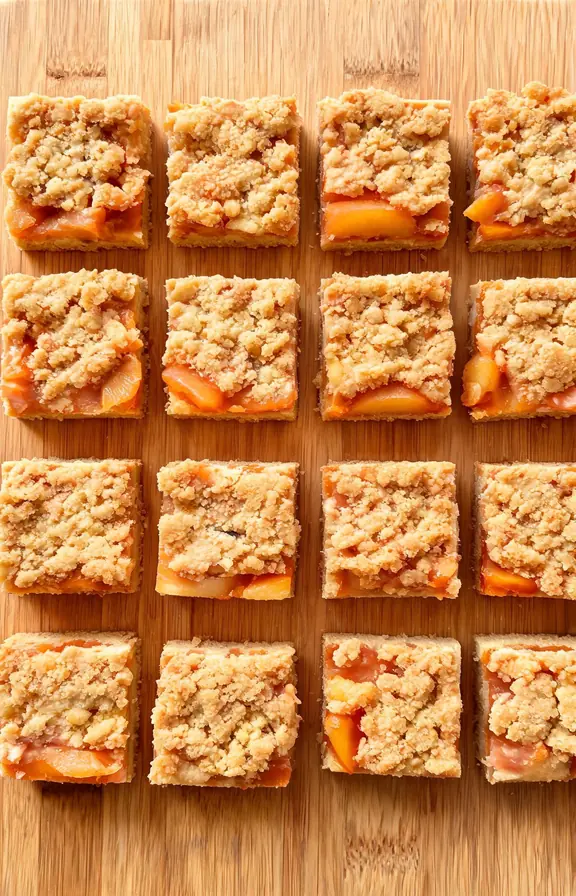
Why Cornstarch Beats Flour for Peach Pie Filling
Every peach filling needs a thickener, or the juices released during baking will pool and soak the crust below. The two most common choices are flour and cornstarch, and they behave very differently in the oven.
Flour thickens at a lower temperature than cornstarch, which sounds convenient, but it also leaves the filling slightly cloudy and pasty tasting if it is not fully cooked through. Cornstarch needs a higher temperature to fully activate, yet it produces a filling that is glossy, clear, and clean tasting once it sets.
For a bar that needs to slice into neat squares rather than a rustic pie wedge, that glossy, firmer set matters. Cornstarch also breaks down less during the longer bake time these bars need to fully cook the crumb topping.
Peeling a Whole Bowl of Peaches Fast: The Blanch Method
Peeling six peaches with a knife or vegetable peeler is slow, and it strips away a surprising amount of the flesh along with the skin. Blanching solves both problems at once.
Score a shallow X at the base of each peach, then lower them into boiling water for 30 to 45 seconds until the scored skin visibly starts to curl back.
Transfer immediately to an ice bath to stop the cooking. The skins should slide off with your fingers, leaving the fruit almost entirely intact.
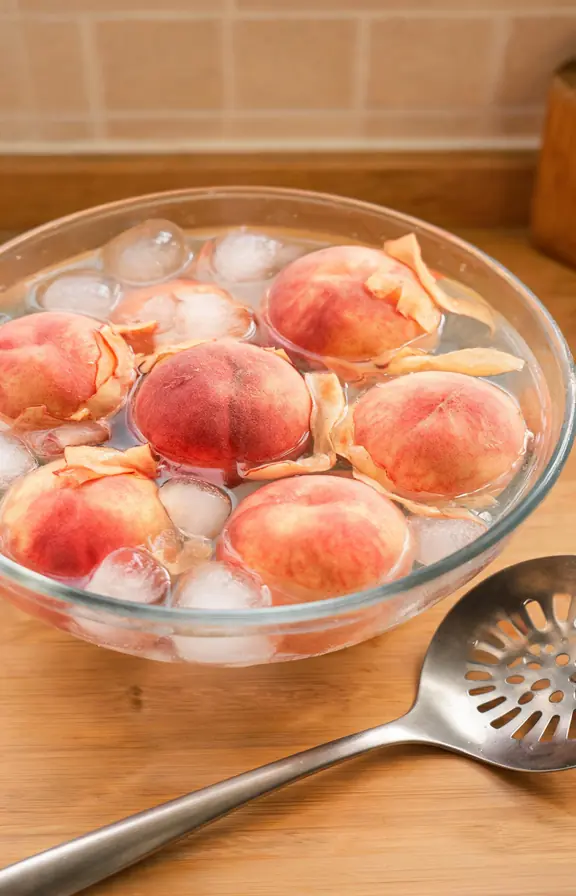
If a peach resists peeling, it likely needs a few more seconds in the boiling water rather than more scraping with a knife. Very firm, underripe peaches will not blanch well, so choose fruit that gives slightly under gentle pressure.
The Double-Duty Crumb Trick: One Mixture, Two Textures
This recipe uses a single crumb mixture for both the base and the topping, which means one bowl and far less cleanup. The trick is in how you divide it.
Two thirds of the mixture gets a beaten egg worked in. That extra binding turns it cohesive enough to press firmly into the pan as a base that will not crumble apart under the peach layer.
The remaining third stays dry and loose. Without the egg, it stays crumbly and separates into the craggy, golden clusters you want scattered over the top.
Do not overwork either portion. Stop mixing the base as soon as it holds together when pressed, and stop working the topping while it is still in pea-sized to marble-sized pieces, not a paste.
9×13 Metal Pan vs. Glass Pan: Which Bakes a Crisper Crumb Topping
This comparison rarely shows up in other peach bar recipes, and it changes your results more than most people expect.
A metal baking pan conducts heat quickly and evenly. The crust pre-bakes faster and the crumb topping browns and crisps more reliably, since metal responds fast to oven temperature changes.
Glass retains heat rather than conducting it quickly, so it takes longer to heat up but holds that heat afterward. This can leave the crust slightly softer and the topping less crisp, though bars baked in glass are easier to judge for doneness since you can see the bottom layer directly.
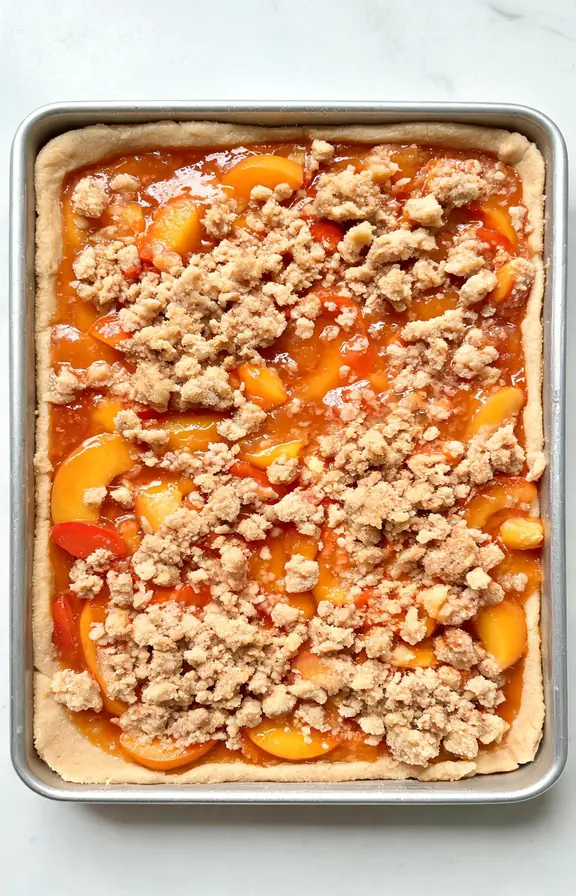
For the crispest crumb topping and the sturdiest base, a light-colored aluminum 9×13 pan is the better choice for this recipe. If glass is all you have, add 5 to 8 minutes to the bake time and watch for visible bubbling rather than relying on the clock.
Reading the Bubble Test: How to Know When Crumb Bars Are Actually Done
Golden color on the crumb topping is not enough on its own to confirm doneness. A pale-looking filling underneath a browned topping is one of the most common reasons crumb bars come out runny after cooling.
The real signal is bubbling. Watch the edges of the pan, not the center. Thick, slow bubbles pushing up around the perimeter mean the cornstarch has fully activated and the filling is setting.
How to Store, Freeze, and Reheat Peach Pie Crumb Bars
These bars keep well for several days, which makes them a genuinely practical make-ahead dessert for warm weather gatherings.
Store cooled, cut bars in an airtight container in the refrigerator for up to 4 days. The chilled cornstarch filling stays firm and slices cleanly straight from the fridge.
To freeze, wrap the whole cooled slab tightly in plastic wrap before slicing, then freeze for up to 3 months. Freezing whole rather than pre-cut helps the crumb topping keep its texture.
Thaw overnight in the refrigerator, then slice once fully thawed. For a warm serving, place individual bars in a 300°F oven for 8 to 10 minutes rather than microwaving, which softens the crumb topping.
Frequently Asked Questions
Peach Pie Crumb Bars
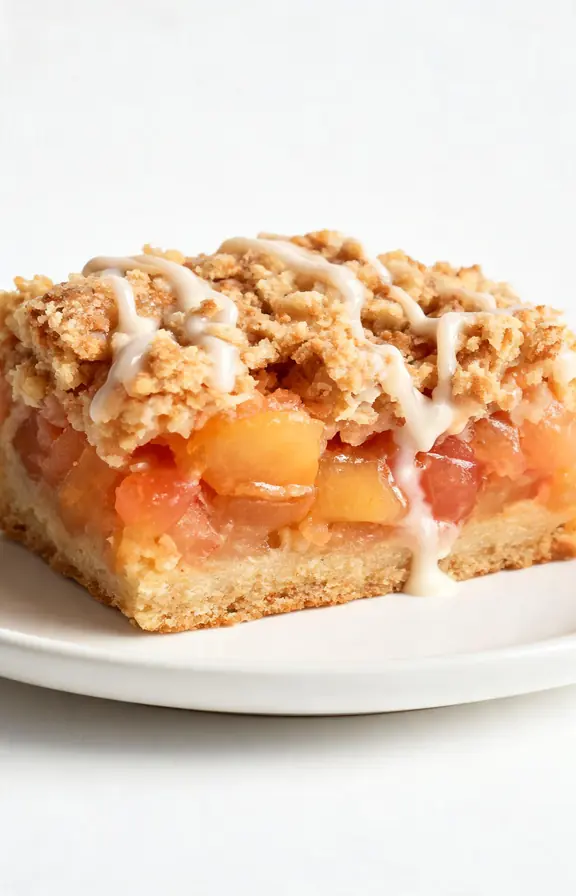
Buttery oat crumb bars with a juicy fresh peach filling that slices clean thanks to a cornstarch-set filling. One crumb mixture doubles as both crust and topping for easy prep.
- Large pot (for blanching peaches)
- Slotted spoon and bowl of ice water
- Large mixing bowl
- Pastry cutter or fork
- 9×13 inch metal baking pan
- Parchment paper
- Kitchen scale
- Wire cooling rack
- 2 1/2 cups (313g) all-purpose flour
- 1 cup (213g) packed light brown sugar
- 1 cup (90g) old-fashioned rolled oats
- 1 teaspoon (3g) ground cinnamon
- 1/2 teaspoon (3g) fine sea salt
- 1 cup (226g) unsalted butter, cold, cubed
- 1 large egg, cold
- 5 cups (about 6 medium) fresh peaches, peeled and diced
- 1/3 cup (67g) granulated sugar
- 3 tablespoons (24g) cornstarch
- 1 tablespoon (15ml) fresh lemon juice
- 1/2 teaspoon (3g) ground cinnamon
- Pinch of fine sea salt
- 3/4 cup (90g) powdered sugar
- 1/2 teaspoon (2ml) vanilla extract
- 2 to 3 tablespoons (30 to 45ml) heavy cream
- Peel and dice the peaches Score a shallow X at the base of each peach. Blanch in boiling water for 30 to 45 seconds until the skin begins to curl, then transfer to an ice bath. Slide the skins off with your fingers and dice the flesh into 1/2-inch pieces. You should have about 5 cups.
- Macerate the peach filling In a large bowl, toss the diced peaches with the granulated sugar, cornstarch, lemon juice, cinnamon, and salt. Let sit for 10 minutes so the sugar draws out excess juice. Stir once more before using.
- Make the double-duty crumb mixture Preheat the oven to 350°F (175°C) and line a 9×13 inch pan with parchment paper, leaving overhang on the sides. Whisk together the flour, brown sugar, oats, cinnamon, and salt. Cut in the cold butter with a pastry cutter or fork until the mixture resembles coarse crumbs. Set aside one third of the mixture in a separate bowl for the topping. Beat the egg into the remaining two thirds until it holds together when pressed.
- Press and pre-bake the crust Press the egg-bound crumb mixture firmly and evenly into the bottom of the prepared pan. Bake for 15 minutes, until just set and lightly golden at the edges. Remove from the oven and leave the oven on.
- Layer the filling Spread the macerated peach filling evenly over the warm, pre-baked crust, including any accumulated juices.
- Add the crumb topping and bake Sprinkle the reserved dry crumb mixture evenly over the peach filling. Bake for 35 to 40 minutes, until the topping is deep golden brown and thick, slow bubbles are visible at the edges of the pan.
- Cool and chill Place the pan on a wire rack and cool completely at room temperature, about 1 hour. Transfer to the refrigerator and chill for at least 2 hours so the filling fully sets before slicing.
- Glaze and slice Whisk together the powdered sugar, vanilla extract, and heavy cream until smooth. Lift the chilled slab out using the parchment overhang, drizzle with glaze, and slice into 16 squares with a sharp knife.
Nutritional values are estimates calculated using standard USDA food composition data. Actual values will vary based on peach ripeness and size, specific flour and butter brands used, and exact bar size after slicing.